
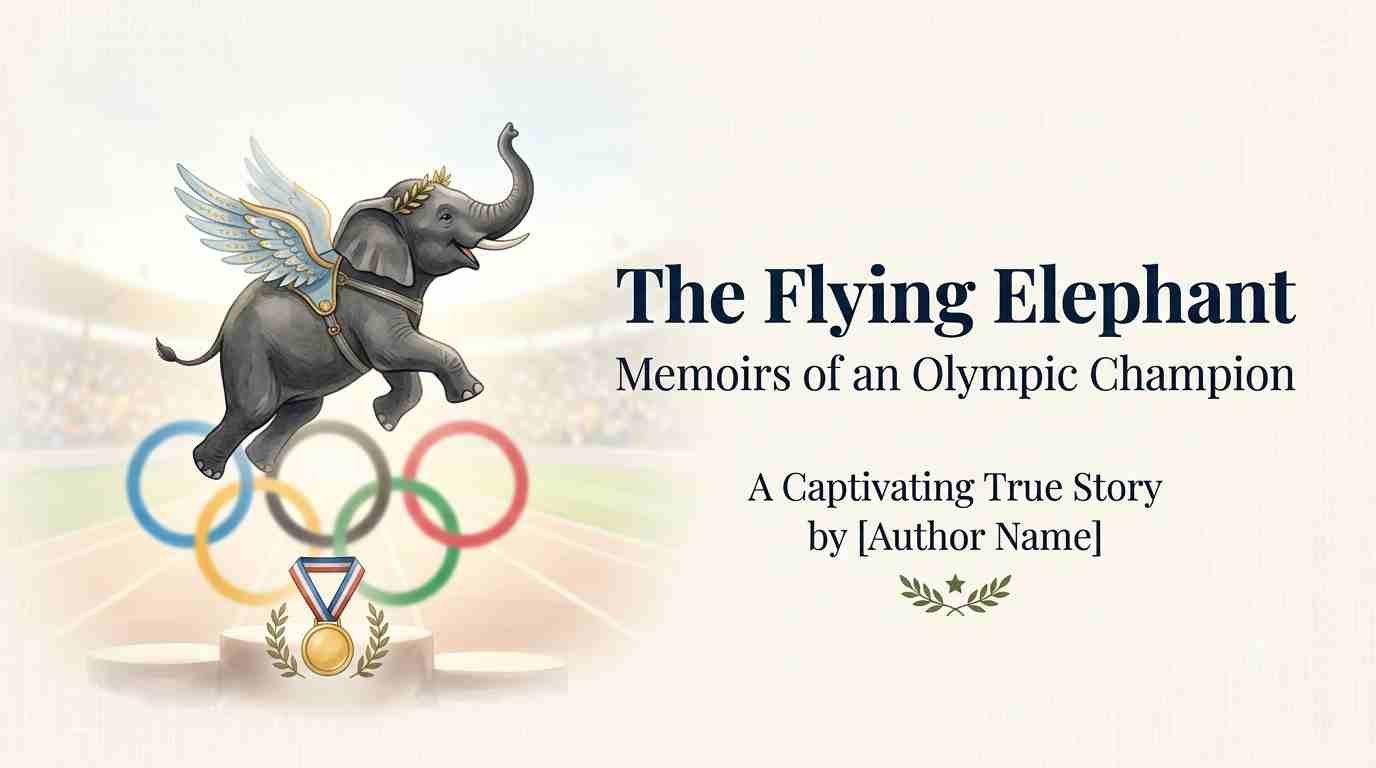
The Flying Elephant: Memoirs of an Olympic Champion (Complete Guide & Review)
Most sports memoirs celebrate victories.
The Flying Elephant: Memoirs of an Olympic Champion goes much deeper, revealing the discipline, sacrifices, and resilience behind Olympic success.
Written by legendary volleyball player Alexander Savin, this memoir offers an honest look at life beyond medals and championships.
In this guide, you’ll discover what the book is about, its key themes and lessons, what makes it unique, and whether it’s worth adding to your reading list.
Quick Facts
| Field | Details |
|---|---|
| Book Title | The Flying Elephant: Memoirs of an Olympic Champion |
| Author | Alexander Savin |
| Genre | Sports Memoir / Autobiography / Biography |
| Format | Kindle Edition (English) |
| Length | 514 pages |
| Photographs | Over 240 rare archival images |
| Translators/Editors | Andrei Savine, Julia Savine, Alfredo Cabero |
| Introduction By | Peter Murphy |
| Language | English (translated from Russian) |
| Main Theme | Discipline, resilience, and the human cost of Olympic excellence |
| Ideal Readers | Athletes, coaches, sports historians, professionals seeking performance lessons |
| Estimated Reading Time | 12–16 hours |
| Overall Rating | ⭐⭐⭐⭐⭐ (5/5) |
What Is The Flying Elephant: Memoirs of an Olympic Champion?
The Flying Elephant: Memoirs of an Olympic Champion is the full autobiography of Alexander Savin, one of the most decorated volleyball players of the Soviet era.
The book spans his entire life—from early childhood in provincial Russia through his rise within the elite Soviet sports system, his Olympic career, his retirement, and his later work as a coach and mentor.
What separates this memoir from the typical athlete biography is its honesty. Savin doesn’t present himself as a naturally gifted superstar who glided through competition.
He writes about doubt, sacrifice, exhaustion, and the institutional pressures that governed every aspect of an athlete’s life inside the Soviet sports apparatus.
The English edition was produced as a family project. Savin’s brother, Andrei Savine, led the translation alongside Julia Savine and Alfredo Cabero.
That family involvement explains why the narrative voice feels close and personal rather than polished by outside ghostwriters.
With 514 pages and over 240 archival photographs, the book also functions as a visual document. It’s a historical record of a volleyball era that is rarely discussed in English-language sports literature.
📌 Key Takeaway: This isn’t just a volleyball story.
It’s a detailed account of what elite performance requires across decades—the mental conditioning, physical repetition, and team culture that sit beneath every medal.
Who Is Alexander Savin?
Alexander Savin is a former Soviet volleyball player widely regarded as one of the greatest middle blockers in the history of the sport. Born in Russia during the Soviet era, Savin rose through the highly organized and competitive Soviet sports system before becoming a central figure in the national volleyball program.
Background and Early Life
Savin grew up in provincial Russia, far from the major urban athletic centers that typically produced elite Soviet players. The memoir spends real time on these formative years, showing how early habits, physical development, and a competitive mindset took shape long before organized national competition entered the picture.
His path into elite volleyball wasn’t fast or glamorous. It involved years of structured training within the Soviet club system before he eventually joined CSKA Moscow, one of the premier sports clubs in the country, and then earned selection for the national team.
Career Achievements
Savin’s playing résumé is exceptional by any standard.
| Achievement | Year(s) |
|---|---|
| Olympic Silver Medal — Montreal | 1976 |
| Olympic Gold Medal — Moscow | 1980 |
| FIVB World Cup Gold | 1977, 1981 |
| FIVB World Championship Gold | 1978, 1982 |
| European Championship Gold | 1975–1985 (six titles) |
| International Volleyball Hall of Fame | Inducted 2010 |
He represented the Soviet Union across two Olympics and multiple World Championships, competing during what many historians consider the golden era of Soviet volleyball.
Life After Playing
Savin transitioned into coaching after retirement, applying the same standards and philosophies that had defined his playing career to the development of younger athletes. That second chapter of his career is documented in the memoir’s later sections and adds meaningful depth to the book’s overall message about knowledge transfer and long-term development.
Why Savin’s Story Still Matters
Savin competed in an era when volleyball received almost no global commercial attention outside Eastern Europe and Japan. The Soviet program built its dominance through structure, discipline, and collective culture rather than individual star power. His memoir preserves that model in detail—a model that modern coaches and athletes can still study and apply.
The Story Behind the Title: Why “The Flying Elephant”?
The title is the first thing readers notice, and it earns its place.
An elephant flying is physically impossible. That impossibility is the point.
The image captures what elite athletic achievement looks like from the outside—something that appears to defy the ordinary limits of human capability.
Savin uses this metaphor to reframe how we think about extraordinary performance. The “flying elephant” doesn’t succeed through magic or natural gifts. It succeeds because the gap between “impossible” and “achieved” is filled with years of deliberate preparation. From a distance, the result looks miraculous. From the inside, it’s just accumulated work.
What the Metaphor Teaches Readers
- Big goals look impossible before the preparation closes the gap. Most meaningful objectives appear unreachable at the start—that appearance is expected, not a signal to stop.
- Consistency is the mechanism, not motivation. The metaphor isn’t about a single burst of heroic effort. It’s about showing up through the years when no one is watching.
- Extraordinary results grow from ordinary repetition. Every jump, every blocking drill, every tactical session is a brick. Savin’s memoir is the story of laying those bricks.
💡 Did You Know? The title was not a common metaphor in Soviet sports culture. Savin’s use of it reflects a self-aware perspective on how his own achievements looked to the outside world—impressive but built on foundations most observers never see.
Book Overview
The memoir follows a full-life structure, moving chronologically from childhood through competitive peak to post-playing career. It doesn’t jump between timelines or skip to the medals and work backward. Savin traces each stage in sequence, which gives readers a clear sense of how each phase built the next.
The book’s 514 pages are supported by over 240 archival photographs, covering training sessions, championship matches, teammates, coaches, and travel across decades of competition. For readers interested in volleyball history, these images alone provide significant value—many have never appeared in English-language publications before.
The English translation maintains a personal tone throughout, largely because the translation was handled by family rather than commercial translators. Sentences don’t feel like they’ve been processed through a corporate editorial filter. The voice belongs to Savin.
Story Summary
(Spoiler-light summary — key story beats without revealing memoir-specific personal details)
The Early Years
Savin’s story begins in small-town Russia, where athletic ability emerged early but without any obvious path to elite competition. The memoir devotes genuine attention to this period, exploring the community, the mindset, and the early physical habits that would eventually support an Olympic career. These chapters establish a foundation for everything that follows.
Entering the Soviet Sports System
The transition into organized, high-level competition is one of the most vivid sections of the book. Savin describes what it meant to operate within the Soviet sports apparatus—the structured schedules, the coaching philosophies, the expectations placed on athletes representing the state. This was not a system built for individual expression. It was built for collective excellence, and Savin navigates that tension honestly.
His time with CSKA Moscow is covered in detail, including the technical and tactical education he received and the personal adjustments required to compete and survive at that level.
Olympic Competition
The Olympic sections are the memoir’s emotional core. The 1976 Montreal Games, where the Soviet team won silver, are recounted with a mix of competitive pride and honest disappointment. Savin doesn’t pretend the result felt like success at the time.
The 1980 Moscow Games, played on home soil under an enormous weight of national expectation, receive even deeper treatment. Winning gold at a home Olympics is the pinnacle of what Savin describes—not because of the medal, but because of what the journey leading to that night had cost.
Life Beyond the Game
The memoir doesn’t stop at retirement. Savin covers his transition into coaching and mentorship, showing how the lessons absorbed over a career became a curriculum he passed on to younger athletes. This section gives the book a structural completeness that many sports memoirs lack. It isn’t just the story of a champion. It’s the story of what a champion does with everything they’ve learned.
Main Themes
Perseverance
Perseverance runs through every chapter. Savin’s path from provincial Russia to Olympic gold spanned years of unglamorous work with no guarantee of reward. The memoir makes clear that continuing through doubt and difficulty wasn’t heroic—it was simply necessary. Elite careers aren’t built by those who feel most motivated. They’re built by those who keep going when motivation fades.
Discipline
The Soviet sports system demanded extraordinary discipline, and Savin’s memoir documents what that looked like in practice. Training schedules were structured and non-negotiable. Personal habits were expected to align with athletic goals. Discipline here isn’t framed as punishment—it’s framed as the foundation that makes everything else possible.
Leadership
Savin’s leadership style, as he describes it, was quiet. He led by consistency, by standard, by example rather than by speech. The memoir presents this as a deliberate choice. On a team built on collective performance, loud individual leadership often disrupts rather than builds. The most effective captains Savin encountered—and the kind he tried to become—held the standard without demanding the spotlight.
Mental Strength
Mental toughness is addressed throughout the book, but Savin’s approach to the subject is practical rather than inspirational. Confidence, he argues, comes from preparation—not from personality. Athletes who trust their training under pressure perform at their level. Those who don’t trust it rarely rise above it. That confidence is built in practice, not found in game-day speeches.
Success
Savin’s definition of success shifts across the memoir. Early chapters focus on progression—making the team, improving the ranking. Later chapters redefine success around contribution: developing teammates, winning collectively, and eventually shaping the next generation. The book subtly argues that personal achievement is incomplete without that larger dimension.
Failure
Losses are not minimized in this memoir. The 1976 silver medal is described honestly as a painful outcome, not a near-win to be celebrated. Failures, in Savin’s account, are treated as data—precise feedback about what needs to change. That approach to setbacks is one of the book’s most practically useful lessons.
Teamwork
Individual talent in volleyball only matters within a functioning team. Savin’s memoir returns repeatedly to the culture of collective accountability. Trust wasn’t assumed among Soviet teammates—it was built through repetition, shared sacrifice, and consistent communication. The chapters on team dynamics offer some of the most transferable insights in the entire book.
Determination
Determination in this context means staying committed to long-term goals through years when no external reward is visible. Savin describes periods in his career where the path forward was unclear and the results weren’t coming. Determination, as he presents it, is not a feeling. It’s a decision made repeatedly, often against the grain of how you feel in the moment.
Motivation
Savin’s memoir is honest about motivation’s limits. The athletes who built the most durable careers in the Soviet system weren’t those who felt most motivated. They were those who had internalized a standard and worked to that standard regardless of how they felt on any given day. Motivation is described as useful but unreliable—discipline is the structure that fills the gaps.
Personal Growth
The arc of the memoir is ultimately one of personal growth. Savin at the end of the book is a different person from the young athlete in the early chapters—not just older and more decorated, but more self-aware, more patient, and more invested in others’ development than his own recognition. That transformation is traced honestly across hundreds of pages.
Key Lessons Readers Can Learn
1. Consistency Outperforms Motivation
Explanation: Motivation fluctuates. Discipline doesn’t. Savin’s training schedule didn’t change based on how he felt on a given morning.
Real-World Application: Build systems and routines that run regardless of enthusiasm levels. Rely on structure rather than mood.
Example from the Memoir: The repetitive blocking drills Savin describes weren’t performed because he felt inspired that day. They were performed because they were on the schedule.
2. Confidence Is Built, Not Born
Explanation: Savin links confidence directly to preparation quality, not natural personality.
Real-World Application: Before high-stakes situations, invest more in preparation. Trust in your performance will follow from the quality of your readiness.
Example from the Memoir: The 1980 Olympic final wasn’t won on adrenaline. It was won on thousands of hours of prior work that players could fall back on under pressure.
3. Failure Provides Feedback, Not Finality
Explanation: Losses are treated in the memoir as information, not endings.
Real-World Application: After setbacks, conduct honest reviews. Identify what specifically went wrong and what changes those findings require.
Example from the Memoir: The 1976 silver medal loss shaped the adjustments that led to the 1980 gold. It wasn’t a scar to hide—it was a blueprint to use.
4. Team Culture Is a Competitive Advantage
Explanation: Individual talent has a ceiling without team trust.
Real-World Application: Invest in relationships, communication, and shared accountability within any team environment.
Example from the Memoir: The Soviet national team’s dominance wasn’t built on star players. It was built on collective systems that maximized what each player could contribute.
5. Long-Term Thinking Produces Long-Term Results
Explanation: Savin’s coaches prioritized gradual development over short-term wins. That philosophy shaped how he played and how he later coached.
Real-World Application: Resist the pressure for fast results when sustainable improvement is possible. Short-term gains built on weak foundations don’t last.
6. Small Daily Habits Compound Into Large Results
Explanation: The memoir’s training descriptions focus on small, targeted repetitions rather than dramatic transformations.
Real-World Application: Identify the small daily habits most connected to your goals. Protect and repeat them regardless of schedule pressure.
7. Leaders Set Standards Without Demanding Attention
Explanation: Savin’s description of the most effective leaders he encountered consistently emphasizes quiet, consistent example over vocal authority.
Real-World Application: In team settings, focus on holding your own standard first. Influence follows consistency, not volume.
8. Historical Context Shapes Performance
Explanation: Understanding the Cold War environment helps explain the intensity and structure of Soviet athletics.
Real-World Application: Understanding the context in which you operate—whether organizational culture, market conditions, or team history—helps you make smarter decisions.
9. Mentorship Multiplies Impact
Explanation: Savin’s transition to coaching is presented as the natural extension of his playing career—not a consolation prize but a continuation.
Real-World Application: Share what you’ve learned. Knowledge transferred to others creates value that individual achievement alone cannot.
10. The Process Matters More Than the Result
Explanation: The memoir’s entire frame rests on this idea. The medals are mentioned, but the focus is always on what produced them.
Real-World Application: Evaluate your progress based on the quality of your process, not just outcomes. Outcomes are partly luck. Process is fully within your control.
Character Analysis
Alexander Savin — Author and Subject
Savin is a compelling memoir subject because he doesn’t sanitize himself. He presents self-doubt alongside achievement, frustration alongside discipline. The reader gets a full picture rather than a curated one.
Strengths: Intense preparation ethic, tactical intelligence, team-first orientation, long-term thinking, emotional honesty in retrospect.
Weaknesses: The Soviet system’s demands left little room for personal life, and Savin acknowledges the cost of that trade-off. His memoir doesn’t dwell on personal relationships outside volleyball, which some readers may find limiting.
Development: The Savin of the early chapters is ambitious and raw. By the memoir’s final sections, he’s reflective and invested in others’ growth. That arc is credible and earned rather than forced.
Coaches and Mentors
Several coaches appear across the memoir and are credited with specific, named contributions to Savin’s development. They’re not background figures. The memoir positions coaches as primary architects of the career, which is unusual in athlete biographies where the athlete typically takes center stage.
Key Pattern: Savin’s best coaches all prioritized long-term development over short-term performance. That philosophy appears again when Savin describes his own coaching approach later in the book.
Teammates
Individual teammates are referenced throughout, though the memoir focuses more on collective team culture than individual personalities. The Soviet volleyball roster of the 1970s and early 1980s appears in archival photographs and match descriptions, but Savin uses these interactions primarily to illustrate broader points about trust and communication rather than to profile specific individuals.
Writing Style Analysis
Narrative Approach
The memoir follows a linear chronological structure from childhood to post-career. That choice reflects Savin’s worldview—cause leads to effect, preparation leads to performance, early chapters explain later results. The narrative doesn’t flash forward to the gold medal and then explain how it happened. It earns each stage in sequence.
Tone
The tone is honest without being self-pitying and confident without being arrogant. Savin writes about his achievements with matter-of-fact directness rather than celebration. He writes about his failures with the same directness. The result is a consistent voice that readers can trust.
Language
Because the English edition is a translation, the language carries occasional traces of the original Russian sensibility—directness, minimal ornamentation, and a preference for concrete description over abstract generalization. For most readers, this works in the memoir’s favor. The writing doesn’t feel bloated or over-processed.
Pacing
At 514 pages, the memoir is long by modern standards. Pacing varies across sections. The Olympic chapters move quickly, carried by competitive tension. The training and developmental sections are slower and more methodical, which mirrors the subject matter accurately. Readers who come expecting a dramatic page-turner may find certain sections dense.
Readability
The English translation reads at a solid accessible level. Technical volleyball terminology is used but generally explained in context. The archival photographs help break up the text and provide visual reference points for readers unfamiliar with the sport’s history.
Why This Memoir Stands Out
Volleyball produces far fewer detailed athlete memoirs than sports like basketball, soccer, or American football. Within that already limited field, memoirs from Soviet-era players are almost nonexistent in English.
The Flying Elephant: Memoirs of an Olympic Champion fills a genuine gap. It provides:
- A firsthand account of the Soviet sports system from an athlete who operated at its highest level across more than a decade
- 240+ archival photographs that document an era otherwise difficult to visualize
- Honest reflection on the cost of elite performance rather than a curated success story
- Transferable lessons that apply well beyond volleyball or sports
The family-led translation also produces something rare—a memoir that sounds like the person who lived it, not a polished commercial product.
Strengths
- ✅ Genuine historical document covering Soviet volleyball’s golden era
- ✅ Honest, unfiltered narrative voice maintained across 514 pages
- ✅ Over 240 archival photographs with rare historical value
- ✅ Practical, transferable lessons on performance, leadership, and resilience
- ✅ Covers the full arc of Savin’s life, not just the competitive peak
- ✅ Avoids the common memoir trap of reducing complex careers to highlight moments
- ✅ Family-led translation preserves the author’s authentic voice
- ✅ Addresses Cold War sports culture in a way that no other English-language volleyball book does
- ✅ Relevant to athletes, coaches, and professionals across fields
- ✅ Inducted author into the International Volleyball Hall of Fame gives historical credibility
Weaknesses
- ⚠️ At 514 pages, the length may deter casual readers
- ⚠️ Pacing slows in developmental and training sections
- ⚠️ Readers seeking dramatic storytelling over honest reflection may find parts dry
- ⚠️ Limited depth on personal relationships outside of volleyball
- ⚠️ Like any memoir, reflects one person’s perspective and memory—not a neutral historical record
- ⚠️ Limited availability in print format outside of the Kindle edition
⚖️ Balanced Assessment: The weaknesses are real, but they’re also features of the book’s approach rather than failures. A shorter, faster, more dramatically shaped version of this story would have been less honest. Readers who accept the memoir’s terms—patience, detail, process—get considerably more than those who come expecting a standard sports narrative.
Who Should Read This Book?
Athletes at Any Level
Whether you play recreationally or compete professionally, the performance principles Savin describes—preparation-based confidence, process orientation, resilience after setbacks—are directly applicable. You don’t need to be an Olympic hopeful to benefit from this book’s approach to competition.
Coaches and Sports Educators
The memoir’s sections on coaching philosophy, long-term development, and mentorship are among the most practically valuable in the book. Coaches who prioritize sustainable player development over short-term results will find their instincts validated and expanded here.
Sports History Enthusiasts
If you’re interested in Cold War sports culture, Soviet athletics, or the history of volleyball specifically, this memoir is essential reading. No other English-language source covers this era from this perspective.
Business Professionals and Leaders
Discipline, team culture, leadership through example, and long-term thinking are not sports concepts. They’re performance concepts that apply in any competitive environment. Business readers who have appreciated books like Legacy by James Kerr or The Obstacle Is the Way by Ryan Holiday will find compatible lessons here.
Students of Performance Psychology
The memoir functions as a practical case study in high-performance psychology—deliberate practice, resilience, intrinsic motivation, and growth mindset—before those terms became mainstream. Readers studying sports psychology or performance science will find real-world examples throughout.
Anyone Working Toward a Difficult Long-Term Goal
The core message of The Flying Elephant is not sport-specific. It’s a book about what it takes to pursue something difficult over a long time without guaranteed reward. That applies as broadly as human ambition.
Comparison With Similar Memoirs
| Book | Author | Sport | Focus | Tone | Length |
|---|---|---|---|---|---|
| The Flying Elephant: Memoirs of an Olympic Champion | Alexander Savin | Volleyball | Process, discipline, team culture | Honest, understated | 514 pages |
| Open | Andre Agassi | Tennis | Internal conflict, identity | Confessional, dramatic | 386 pages |
| My Olympic Life | David Hemery | Athletics | Olympic preparation | Personal, reflective | 272 pages |
| Legacy | James Kerr | Rugby (All Blacks) | Leadership and culture | Analytical, inspirational | 257 pages |
| The Bounce | Matthew Syed | Table Tennis | Talent vs. practice | Evidence-based, accessible | 272 pages |
| Endure | Alex Hutchinson | Endurance sports | Limits of human performance | Scientific, compelling | 304 pages |
When to Choose The Flying Elephant Over These Alternatives:
- Choose The Flying Elephant over Open if you want a process-focused narrative rather than an emotionally dramatic one.
- Choose The Flying Elephant over Legacy if you want a primary source from an athlete rather than an analyst’s observation of a team.
- Choose The Flying Elephant over The Bounce if you prefer memoir over research-based argument.
Memorable Ideas and Key Concepts
(Key ideas summarized without reproducing copyrighted passages)
On extraordinary performance: The book consistently returns to the idea that results which look miraculous from outside were built from unglamorous repetition inside. The gap between “impossible” and “achieved” is filled with ordinary work done consistently.
On the Soviet sports system: Savin’s account makes clear that the system’s strength wasn’t talent identification—it was systematic development. Players were not just selected; they were built.
On losing: The silver medal in 1976 is framed not as near-success but as a precise diagnostic. The specific gaps it exposed were the ones that the 1980 training program addressed.
On coaching: The best mentors in Savin’s career are remembered not for what they said in big moments but for what they demanded in ordinary ones. Standards communicated daily shaped the athlete more than speeches delivered occasionally.
On the title: Flying is not the elephant’s natural state. The achievement is remarkable precisely because it contradicts what the animal is designed to do. Elite human performance operates the same way—we exceed design limits through preparation.
💬 Expert Insight: Sports psychologists who study long-term athlete development often argue that the quality of daily habits—not talent—is the primary variable in career achievement. Savin’s memoir provides a career-long case study supporting that position, written before sports psychology became a mainstream field.
What Makes This Book Inspirational?
The answer lies in what the book doesn’t do. It doesn’t tell you that Alexander Savin was exceptional, then show you his medals as proof.
It shows you the Monday mornings before the medals. The doubts before the confidence. The losses before the gold.
That structure is what makes it genuinely inspiring rather than simply impressive.
Impressive stories create distance.
You read about someone’s gold medal and think, “That’s remarkable.” Inspiring stories create proximity.
You read about someone’s training schedule, their doubt, their recovery from a difficult loss—and you recognize something that feels possible to apply.
The Flying Elephant: Memoirs of an Olympic Champion achieves the second thing consistently.
By the time Savin wins gold in Moscow, the reader has spent hundreds of pages understanding exactly what produced it.
The achievement doesn’t feel like the result of some separate category of human being. It feels like the result of a process. And processes can be studied, adapted, and applied.
That is the book’s greatest gift.
Reader Takeaways
After reading The Flying Elephant: Memoirs of an Olympic Champion, here are the most actionable positions you can take:
1. Audit your preparation, not your results. Results are partially outside your control. Preparation quality isn’t. Savin’s approach was to make the preparation excellent and trust the outcomes to follow.
2. Build a process that runs without motivation. Identify the specific daily and weekly habits most connected to your goals. Create the conditions for them to happen automatically.
3. Treat failure as a diagnostic tool. After any setback, ask: What did this reveal? What specifically needs to change? Then change it.
4. Lead by holding your own standard. The most influential person in any team setting is often not the loudest—it’s the one whose standard never drops. Be that person.
5. Think in years, not weeks. Savin’s career was a decade of compounding development. The most significant results in any field are rarely built in a quarter. Extend your timeline and your patience simultaneously.
6. Share what you’ve learned. When you’ve developed something genuinely useful—a skill, a standard, a perspective—the next step is transferring it. Coaching others compounds your own investment.
FAQs
Is The Flying Elephant: Memoirs of an Olympic Champion a true story?
Yes. It is an autobiographical memoir based entirely on Alexander Savin’s real experiences as a Soviet volleyball player, Olympic competitor, and coach.
Who wrote The Flying Elephant: Memoirs of an Olympic Champion?
Alexander Savin wrote the original memoir. The English edition was translated and edited by his brother Andrei Savine, along with Julia Savine and Alfredo Cabero. The English edition includes an introduction by Peter Murphy.
What does the title “The Flying Elephant” mean?
The title is a metaphor for achieving something that appears physically or logically impossible. An elephant cannot fly under normal conditions—but elite athletic achievement consistently appears to defy ordinary human limits. Savin uses the image to represent what extraordinary results look like from outside: impossible-seeming, but built from years of deliberate preparation.
Is the book only about volleyball?
Volleyball is the central context, but the themes—resilience, discipline, leadership, teamwork, long-term development—are not sport-specific. Readers from business, education, coaching, and professional fields have found the lessons directly applicable.
How long is the English edition of the memoir?
The English Kindle edition runs 514 pages and includes over 240 archival photographs spanning five decades.
When did Alexander Savin win his Olympic medals?
Savin won a silver medal at the 1976 Montreal Olympics and a gold medal at the 1980 Moscow Olympics, both as a member of the Soviet Union national volleyball team.
Is Alexander Savin in the Volleyball Hall of Fame?
Yes. Alexander Savin was inducted into the International Volleyball Hall of Fame in 2010.
How does the family-led translation affect the reading experience?
Positively, for most readers. Because the translation was produced by Savin’s family rather than a commercial publisher, the narrative voice retains a personal, unfiltered quality. It sounds like the person who lived the story rather than a polished editorial product.
Is this memoir suitable for non-sports readers?
Yes. Readers primarily interested in performance, leadership, Cold War history, or personal development will find genuine value in the book regardless of their interest in volleyball.
How does The Flying Elephant compare to other Olympic memoirs?
Most Olympic memoirs focus on the peak moment—the race, the game, the final. Savin’s memoir focuses primarily on what produced the peak. That orientation makes it more practically useful for readers interested in process and less dramatic for those seeking narrative tension.
What is the best format to read this book?
The English edition is most readily available as a Kindle edition. The digital format allows access to the text across devices, though the archival photographs may display better on tablets than on standard e-readers.
Is this book relevant for modern athletes and coaches?
Yes. Training methods have evolved since Savin’s playing era, but the mental and tactical fundamentals he describes—preparation-based confidence, team trust, long-term development—remain directly applicable.
Final Verdict
Pros
- ✅ One of the few detailed English-language memoirs from a Soviet-era Olympic athlete
- ✅ Exceptional historical value with 240+ archival photographs
- ✅ Honest, process-focused narrative that avoids common memoir clichés
- ✅ Practical lessons applicable far beyond sports
- ✅ Full-life arc, from childhood through post-career coaching
- ✅ Authentic voice preserved through family translation
Cons
- ⚠️ 514 pages demands a patient reader
- ⚠️ Primarily available in Kindle format
- ⚠️ Limited personal depth outside of athletic career
Who Should Buy This Book?
Buy The Flying Elephant: Memoirs of an Olympic Champion if you are an athlete, coach, sports historian, or professional interested in performance, leadership, and long-term development. Buy it if you want a memoir that values honesty over polish and process over highlight reel.
Skip it if you’re looking for a fast-paced dramatic narrative or a book that puts celebrity and individual achievement at the center.
Overall Recommendation
5 out of 5. This is a rare book—detailed, honest, and historically significant. It earns its length because it earns your trust. By the final chapter, you haven’t just read about an Olympic champion. You understand, in concrete terms, what built one.
The Flying Elephant: Memoirs of an Olympic Champion belongs on the shelf of anyone serious about sustained high performance—in any field.
Meta Data
Meta title
The Flying Elephant: Olympic Champion Memoir — Review
Meta description
Discover The Flying Elephant: Memoirs of an Olympic Champion by Alexander Savin. Full review, summary, themes, key lessons, and who should read this sports memoir.