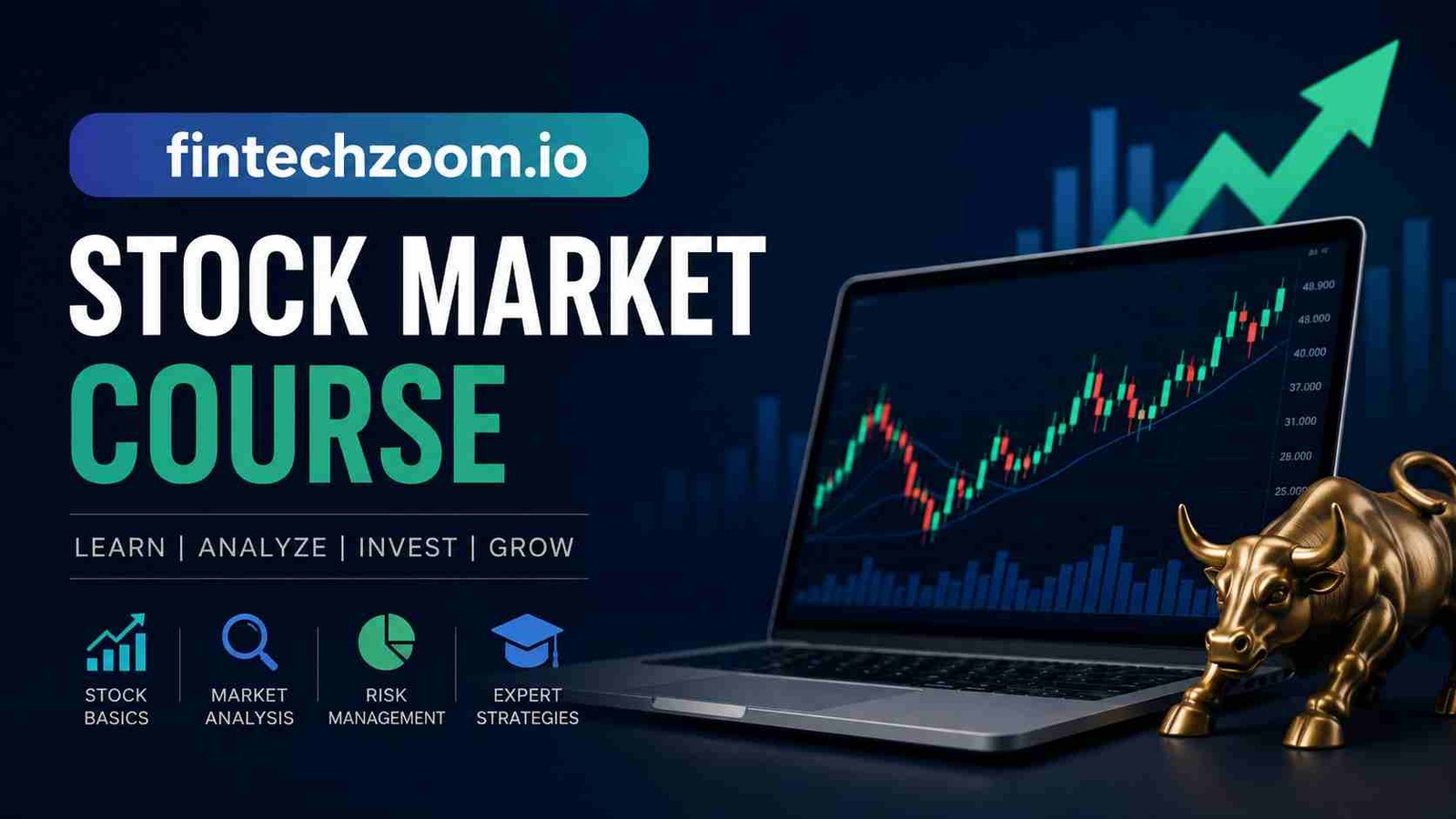
Fintechzoom.io Stock Market Course Review: What’s Verified, What’s Missing, and Who It’s Really For
Let’s cut through the noise. If you searched for the Fintechzoom.io stock market course, you probably want a straight answer, not another page that reads like an ad.
So that’s what you’ll get here — an honest audit of what this course actually offers, what stays unclear, and whether it deserves your money.
We’ll dig into the curriculum, the claims that need checking, and who should walk away. Grab a coffee. This one’s worth reading before you spend a dime.
Quick Verdict: Is the Fintechzoom.io Stock Market Course Worth It?
Here’s the short version. The Fintechzoom.io stock market course can be a solid starting point if you’re a beginner who wants structure instead of scattered YouTube clips and forum tips.
But it’s not for everyone. If you need an accredited certificate, one-on-one coaching, or trade signals delivered to your phone, look elsewhere.
The single most important thing you can do? Verify the pricing, the instructors, and the refund terms directly on the official site before you pay.
A lot of articles online treat marketing promises as facts. We won’t. We’ll separate what’s confirmed from what’s just claimed, so you decide with clear eyes.
What the Fintechzoom.io Stock Market Course Offers
At its heart, this is a self-paced online program. It walks you from the basics of how the stock market works toward more advanced trading and portfolio ideas.
Self-paced simply means you learn on your own schedule. No fixed class dates, no pressure — you watch lessons when life allows and pick up where you left off.
Now, one thing trips people up constantly. Three separate things share the “Fintechzoom” name, and blurring them makes the course sound bigger than it is.
- Fintechzoom.io — a broader finance platform that publishes market news, stock coverage, and crypto updates.
- The platform’s tools — charts, screeners, and dashboards built into the site.
- The stock market course — the specific paid learning program we’re reviewing here.
Keep those three straight. It’ll save you from confusion later.
The course is usually delivered through short video lessons, quizzes, downloadable templates, and simulated practice exercises. That format works well if you learn by doing rather than reading long textbook chapters.
The stated skill range runs from beginner to intermediate. So if you’ve never bought a single share, you’re exactly who this was built for.
Verified vs. Unverified Claims (The Trust Check)
This is the section most reviews skip. It’s also the most important one, so read it twice.
Plenty of write-ups repeat marketing copy as if it were gospel. They say “includes a certificate” or “live coaching available” without checking whether that’s true for every buyer.
You deserve better before spending money. So here’s an honest breakdown of what’s confirmed, what’s fuzzy, and what you should personally check.
| Claim | Verified? | What to confirm yourself |
|---|---|---|
| Beginner-friendly curriculum | Likely | Review lesson pacing or a sample module |
| Certificate on completion | Unclear | Check the official sales page |
| Live coaching or Q&A | Package-dependent | Confirm before purchase |
| Real-time data tool integration | Partly discussed | Ask for screenshots or a demo |
| Named, credentialed instructors | Unclear | Look for public instructor bios |
| Transparent pricing | Unclear | Verify current pricing directly |
Notice how much sits in that “unclear” column. That’s the gap between what gets advertised and what you can actually confirm.
The beginner-friendly structure shows up consistently, so that one’s probably solid. But instructor credentials, exact pricing, and live support all depend on details that third-party blogs simply assume.
Here’s your move before buying. Confirm three things directly on the official site: current pricing, who’s teaching, and the refund policy.
If a site won’t tell you who teaches the course or what it costs, treat that as a warning — not a minor gap.
Who the Course Is For (and Who Should Skip It)
Not every course fits every person. Let’s match this one to real situations so you can see yourself in it.
It’s a good fit if you’re:
- A complete beginner who wants a clear path instead of jumping between random videos that assume you already know the lingo.
- An aspiring trader who wants a foundation in charts and strategy before risking real cash.
- A finance student or young learner wanting practical, low-cost knowledge you can fit around classes.
- A busy working professional who needs to study around a full-time job — roughly five to seven hours a week.
- A tech-curious investor interested in how AI and fintech tools shape modern market analysis.
Now, who should skip it?
Skip this course if you need an accredited certificate that counts toward a degree. Skip it if you want one-on-one mentorship with direct feedback.
Definitely skip anything promising guaranteed returns or automated trade signals. No honest course works that way, and anyone claiming otherwise is waving a red flag.
Here’s a simple rule. If you want structure and you’re a beginner, this is worth a look. If you want personal coaching or formal credentials, spend your money elsewhere.
When in doubt, preview a sample lesson before paying a cent.
Course Curriculum Breakdown
Let’s look at what you’ll actually study, and in what order. The course generally follows a logical build — simple first, then layered complexity.
Here’s the typical path:
- Market foundations — how stock exchanges work, the different order types, and who the main players are.
- Investment vehicles — individual stocks, ETFs (exchange-traded funds, which bundle many stocks into one), index funds, and mutual funds.
- Account setup — how to open a brokerage account, what margin means (borrowing money to trade), and how orders get executed.
- Technical analysis — reading charts, indicators, and price patterns.
- Fundamental analysis — reading financial statements and judging what a company is really worth.
- Risk management and psychology — protecting your money and managing your own emotions.
- Strategy building and review — pulling everything into a repeatable plan.
Each stage usually comes as short video modules paired with quizzes and practice exercises. That keeps things digestible instead of dumping a finance textbook on your lap.
Here’s the honest gap, though. No public, detailed syllabus confirms the exact number of lessons or hours per module.
So request the full syllabus before you enroll. A legitimate course will happily hand one over.
Technical & Fundamental Analysis: What You’ll Actually Learn
These two skills are the heart of the course, so let’s make them crystal clear.
Technical analysis studies price and volume charts to help you time your trades. Fundamental analysis studies a company’s financial health to judge its long-term value.
Think of it this way. Technical analysis asks, “When should I buy?” Fundamental analysis asks, “What should I buy in the first place?”
On the technical side, you’ll learn:
- Support and resistance levels — the price zones where a stock tends to stop falling or stop rising.
- Moving averages — like the 50-day and 200-day lines that smooth out noise so you can spot the trend.
- Momentum indicators — tools like the RSI (Relative Strength Index) and MACD (Moving Average Convergence Divergence) that flag when a stock may be overbought or oversold.
- Candlestick patterns and volume — reading the shape of price moves and how much trading backed them.
Here’s a real example that sticks. When GameStop went wild back in 2021, its RSI shot well above 70 — a level that screams “overbought.”
That’s the exact warning sign this module teaches you to catch before you chase a spike into a crash. Painful lesson for many; a chart-reading skill for you.
On the fundamental side, you’ll learn to:
- Read an income statement and balance sheet — the reports showing revenue, profit, and what a company owns versus owes.
- Analyze cash flow — because a company can look profitable on paper yet still run dry on actual cash.
- Use valuation ratios — like the P/E ratio (price-to-earnings) and EPS (earnings per share) to compare companies.
Another quick example. If Apple trades at a P/E ratio of 30 while its industry average sits near 20, investors are paying a premium.
That’s not automatically bad — but you’ll want to understand why before buying. Maybe growth justifies it. Maybe it’s hype. The course teaches you to tell the difference.
One caveat worth tattooing on your brain. No indicator guarantees an outcome. Treat every tool as a way to make smarter decisions, not a crystal ball.
Risk Management & Trading Psychology
For most beginners, this section matters more than any fancy strategy. Honestly, it might be the most valuable part of the whole program.
You can pick the perfect stock and still lose money if you bet too big or panic at the wrong moment. Managing risk is what keeps you in the game long enough to actually get good.
The course covers the core risk tools:
- Position sizing — deciding how much to risk per trade, often capped at 1% to 2% of your account.
- Stop-loss orders — automatic sell orders that cap your loss before it snowballs.
- Risk-reward ratios — weighing your potential gain against your potential loss before you enter.
- Diversification — spreading money across sectors so one bad pick can’t sink you.
It also tackles the mental traps that wreck good plans:
- FOMO (fear of missing out) — the itch to buy after a stock has already soared, exactly what burned thousands during the meme-stock frenzy.
- Loss aversion — clinging to losers too long because selling feels like admitting you were wrong.
- Overtrading and confirmation bias — trading out of boredom, or only reading news that agrees with a bet you already made.
Here’s a habit worth building on day one. Keep a trading journal and review it monthly. Writing down why you made each trade turns your own mistakes into your sharpest teacher.
Want a free, trustworthy grounding on the basics? The U.S. Securities and Exchange Commission runs investor education pages that cost nothing and are genuinely worth your time.
Tools, Resources & the AI Angle
Knowledge stalls fast without the right tools. Here’s the working toolkit the course points you toward.
- Charting platforms — for viewing price movement and layering on technical indicators.
- Stock screeners — filters that narrow thousands of companies to a short list based on your criteria.
- Economic calendars — trackers for earnings reports, Federal Reserve meetings, and other market-movers.
- Paper trading simulators — practice accounts that let you trade fake money with real prices.
- News aggregators and portfolio trackers — for staying informed and watching your holdings in one place.
If the AI angle is what drew you in, pay close attention here. The course talks about AI-driven analysis tools — but these features get discussed far more than they get demonstrated.
So don’t assume they’re included in your package. Ask for a live demo or screenshots first. “Real-time data integration” is a claim to verify, not one to take on faith.
And here’s the single most valuable instruction in this whole review. Practice in a paper trading account before you risk one real dollar.
Most beginners who skip this step lose money faster than they ever expected. Don’t be that story.
How It Compares to Free and Paid Alternatives
This course isn’t your only option. Let’s see where it actually fits among the crowd.
| Learning option | Best for | Typical cost |
|---|---|---|
| Fintechzoom.io course | Structured, self-paced beginners | Varies — verify directly |
| Free resources (YouTube, Investopedia) | Budget learners who are self-directed | Free |
| University finance courses | Academic depth or credentials | High |
| Coursera or Udemy | Comparing multiple instructors | Low to moderate |
| One-on-one mentorship | Active traders wanting feedback | High |
A few honest takeaways. Free resources build your vocabulary well, but they rarely hand you a clear path — so you end up with knowledge full of holes.
University courses go deep on theory but often lag behind the tools traders actually use day to day. Mentorship gives the best feedback, but the price usually puts it out of reach for casual learners.
Here’s how to choose based on who you are:
- On a strict budget? Start with free resources plus one structured course.
- Focused on long-term investing? Prioritize fundamentals over fast trading content.
- Want a credential for your résumé? A university or accredited program beats this.
- When in doubt? Pick whichever offers a preview or a refund policy.
That last rule protects you no matter which way you lean.
Realistic Outcomes: What You Can Do After the Course
Let’s set honest expectations, because most reviews won’t. Finishing a course won’t make you rich — but it can make you competent. That’s the real win.
After roughly 30 days of steady study, you can realistically expect to:
- Read a basic price chart without feeling lost.
- Understand order types and set up a brokerage account.
- Apply simple risk rules, like capping each trade at a small percentage.
- Practice trades confidently in a simulator.
Here’s what the course will not do — and be wary of anyone claiming otherwise:
- Guarantee profits.
- Replace years of hands-on market experience.
- Turn you into a professional trader in a few weeks.
Hold onto one mindset above all. Markets reward consistency far more than they reward prediction.
The person who follows a plan for years usually beats the one chasing the next hot tip. Boring? Maybe. Effective? Absolutely.
Red Flags & Buyer’s Due-Diligence Checklist
Before you enter your card details, run through this quick scan. It takes five minutes and can save you real money.
Warning signs to watch for:
- Unclear or missing instructor bios.
- Vague pricing with no clear total shown.
- No sample lesson or free preview.
- No detailed syllabus available on request.
- No sign the content gets updated regularly.
- Broad claims with zero screenshots or demos to back them.
- Blurred lines between course content and the platform’s separate features.
Any one of these alone isn’t a dealbreaker. Several together? That’s your cue to pause.
Now flip it around. Here’s a pre-purchase checklist worth screenshotting:
- ✅ Can you preview a syllabus?
- ✅ Are the instructors named and credentialed?
- ✅ Is pricing clearly shown?
- ✅ Is there a sample lesson?
- ✅ Is the refund policy visible?
- ✅ Does content get updated regularly?
If you can check every box, you’re on much safer ground.
One more thing. Watch the domain carefully. Fintechzoom.io, Fintechzoom.com, and other similarly named sites are easy to mix up.
Similar branding doesn’t prove shared ownership or content. So confirm exactly which site you’re buying from before trusting a single claim.
Final Verdict & Transparency Scorecard
Time for the honest wrap-up. Here’s how the Fintechzoom.io stock market course scores across the factors that matter — with unverified fields marked honestly.
| Category | Score | Notes |
|---|---|---|
| Curriculum depth | 7/10 | Logical, beginner-to-intermediate path |
| Transparency | 4/10 | Pricing and instructors often unclear |
| Beginner friendliness | 8/10 | Strong structure for newcomers |
| Tool integration | 5/10 | Discussed more than demonstrated |
| Practical value | 7/10 | Real exercises and simulated practice |
| Trustworthiness | 5/10 | Needs first-hand verification |
| Value for money | 6/10 | Depends on the price you confirm |
Read that scorecard as a nudge, not a final grade. The low transparency and trust scores aren’t saying the course is bad — they’re saying you have to do the checking the marketing pages won’t.
So here’s your decision rule, broken down by who you are:
- Complete beginner wanting structure? This can be a genuinely useful starting point, once you confirm pricing and who’s teaching.
- Busy professional or student? The self-paced format fits your schedule well.
- Want credentials or coaching? Put your money somewhere else.
The bottom line? The Fintechzoom.io stock market course brings together the pieces most beginners struggle to find in one place — structured lessons, analysis training, risk principles, and practice tools.
It won’t turn you into a pro overnight. No course honestly can. But paired with consistent practice and a written plan, it can be a real step toward becoming a more confident, informed investor.
Before You Decide
Take one small step first. Preview a sample lesson, confirm the current price, and check the refund policy.
Then choose with confidence — whether that’s enrolling here or picking an alternative that fits you better. Either way, you’ll be deciding on facts, not hype.
Disclaimer: This article is for educational purposes only and is not financial advice. No course, tool, or strategy can guarantee investment profits. All investing carries the risk of loss, and past performance never guarantees future results. Always do your own research and consider your personal circumstances before investing.